The dandie dinmont is believed to originate mainly from different northern english terrier crossings, and it is closely related to the bedlington terrier. A family named Allan, living in Holystone not far from Rothbury, played an important role in the shaping of the breed. William Allen, often called Piper-Allen, was famous for his small hunting terriers, as was his son.
The breed name was given in 1815, when Walter Scott's roman 'Guy Mannering', where the terriers 'Mustard' and 'Pepper' are described, was published. Guy Mannering was fictional, but bore close resemblance to a real farmer named James Davidson, and his dogs were the ones mentioned in the book,. These dogs came from James Allan. After 'Guy Mannering' the dandie dinmont became very popular, and was soon turned into a companion dog, rather than a hunter.
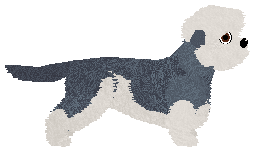
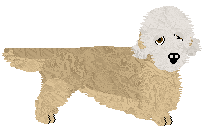
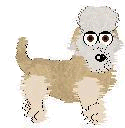
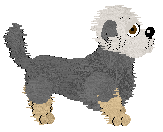
The dandie dinmont terrier is a sporty and confident breed, with a very typical head, which should be strong and powerful, with well developed jaws. The muzzle should be shorter than the skull. The ears are set low and far back on the head. The neck is very strong and muscular. The body is long, strong and agile, with a deep chest and high back, forming a typical curve. Short legs, with the hind somewhat longer than the front. The coat consists of a soft undercoat, while the topcoat is harder.


 with
with 


 markings in the traditional or creeping Tan: pattern.
 or
or  (faulted). May have
  (preferred) or