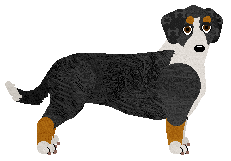
The drever, formerly known as swedish dachbracke, originates from dogs imported to southern Sweden in the 1910s. The breed was relatively unknown until the 1930s, when it was discovered that it was an excellent choice for the roedeer hunter. Roedeer was once very rare in Sweden, but now the species began to become much more common, and more and more hunters found out about the drever. A few but serious breeders created the foundation for what would be known as 'the' hunter's choice when it came to huntability. In 1957 this breed was named 'drever' (the name was decided after a naming contest in a newspaper, and comes from 'driva' which can be translated as 'to drive' or 'to push' - 'drever' is hence 'driver').
The drever is the obvious choice in Sweden for roedeer hunters, but also successfully used for hare and fox hunting. It is often known as a 'hunting machine' and almost never kept as a companion only.
The drever should be rather elongated with deep chest and short, powerful legs with tight paws. It should appear strong and robust and mustn't look elegant or fragile. The neck should be strong and held proud. The head is elongated and shaped like a rounded wedge with tight lips. The eyes should be expressive with a purposeful gaze. The ears are set low. The tail is long and preferably carried hanging.
Overall, the drever should be built as a slower hunter, strong and able to work in the swedish climate.


 striping.
 in the irish spotting pattern, Strict is preferred. Slight ticking is allowed.

 . Solid red dogz may have
  as solid or dudley.