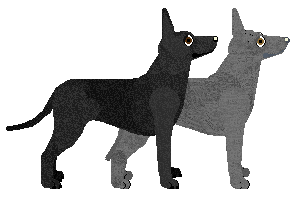
Hairless:
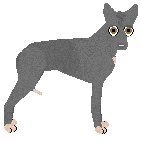
Solid: Due to being hairless, the colour is determined by skin tone rather than fur colour. Several skin tones can be used for the same 'colour'. If all else is equal, the darker colours are the most preferred.
Black:


Blue:
Liver:


Isabella:
Red:

The muzzle (may include the whole face), and/or feet (may include ankles/wrists) are allowed to be darker than the rest of the body. Another darker colour within the same 'colour group' should be used.
Coated topknot/tailtip (if present): Uses one of the colours in the respective colour groups. Black dogz may use
. For all colours, the coated areas may be part or solid  .
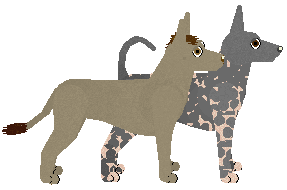
.White Markings: Any pattern is allowed, ticking is allowed in any degree. White in this breed must be represented by using pale pink on all hairless areas, while coated areas must use
.Because of the lack of fur, this breed does not fully follow the traditional white guidelines. The dog is allowed to have smaller pink spots to any degree (even if it has no white spotting elsewhere). If the spots are sparse, they should be limited to mainly the legs and/or front of chest. If they are many, they can be all over the dog. Pale pink feet, tailtip or front of chest are not required if the dog has these spots.
Coated:
Solid:
Black:
Blue:
Liver:
Isabella:
Red:
Sable: All types of sable are accepted in the minimal pattern with shading the forum of tipping only.
Brindle: One of the following combinations:
with striping with striping with stripingTan:
with or with in the traditional, creeping pattern or saddle pattern. Points may be brindled.Masking: solid
, sable, brindle and tan point may have small or standard mask. Mask is and matches pigment type.White Markings: May have
in the trim, irish spotting, or piebald pattern. Slight to light ticking is allowed.
 (preferred) or
  in black dogz,
  in blue, livers and isabella. Red and cream dogz have either depending on whether they have black, liver, blue, or isabella nose pigment.
 in black dogz
  in blue dogz
 in isabella dogz