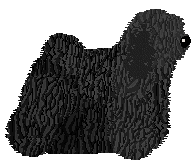
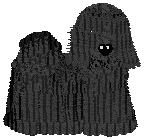
Also known as Hungarian Puli, this breed is believed to have come to Hungary with the magyars, who immigrated during the 800's. Many believe that it is related to the tibetan terrier, which it resembles not only in its general body build, but also in the way it jumps. The puli has been kept as a herding dog for hundreds of years, but it may also have been used for hunting. To keep track of where the herd is, while running in the tall grass, it will jump straight into the air to get a look around! It can also run on the back of the sheep. The thick coat protects it from both heat and cold.
The first breed standard for the puli (the word 'puli' has no special meaning) was written in 1915 and it was recognized in 1924. In most countries it is held as a companion dog, but it is still a lively and very trainable dog. The coat requires extensive care and takes very long to dry after a bath.
The puli should give the impression of a medium size, powerful, heavily coated and agile dog. The head is small, with little stop and rounded muzzle. The eyes have a lively expression. The ears are set at medium height and rather v-shaped. The neck is of medium length, because of the coat the transition from body to head is barely noticable. The body is of medium length, with deep chest and slight tuck up. The tail is hard to see in the long coat, which should consist of a fine undercoat and coarse topcoat, together forming long strings over the entire dog.


 - Last may have a bit of
  on the muzzle to represent staining.