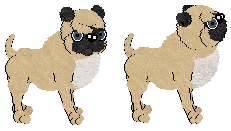
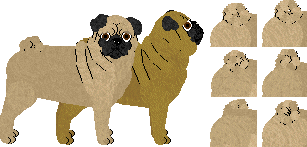
The pug originally comes from China, and short-muzzled dogs were mentioned as early as 557 B.C in chinese literature. Pai- and Hapa-dogs are described as flat-nosed, small and shorthaired. In the 1200's the breed reached Russian via home-returning soldiers, but after that it did not come to Europe again until the 1700's, when it reached Holland. The pug was kept as a royal dog, and as such it was introduced in England in 1688.
The name 'pug' is believed to come either from the royal pet monkeys that were called the same thing, or from latin 'pugnus' (fist), to illustrate the breed's special headshape.
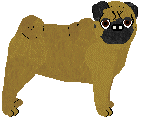
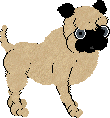
The pug should give the impression of being a square-shaped, compact, powerful, lively and happy dog. The head is large and round, with a short and square muzzle. The eyes are large with a mild and alert expression. The ears are small and thin, carried tipped over and close to the head. The neck is powerful and coarse, carrying the head high. The body has a short, compact and broad chest and straight back. Straight frontlegs, good angulation in hind. The tail is curled tightly. The coat is short, soft and close-laying.


 or may use
  base colour and the shading may be
  or
or 
 in PFM file only, less preferred